Discovery · Episode three
The river that fed the world
An illustrated voyage from the port of Lothal toward the cities Mesopotamia called a partner. The story stays a story. The desk beside it shows what seals, cargo and findspots support — and what they do not read.
Story by Nick Collins, “The True Cradle,” Episode Three. Artwork made with Midjourney — illustration, not a published plate and not a tracing of a seal. Evidence notes are Induscript’s, not a missing essay passed off as his.
Twenty illustrated panels, with the claim beside each line
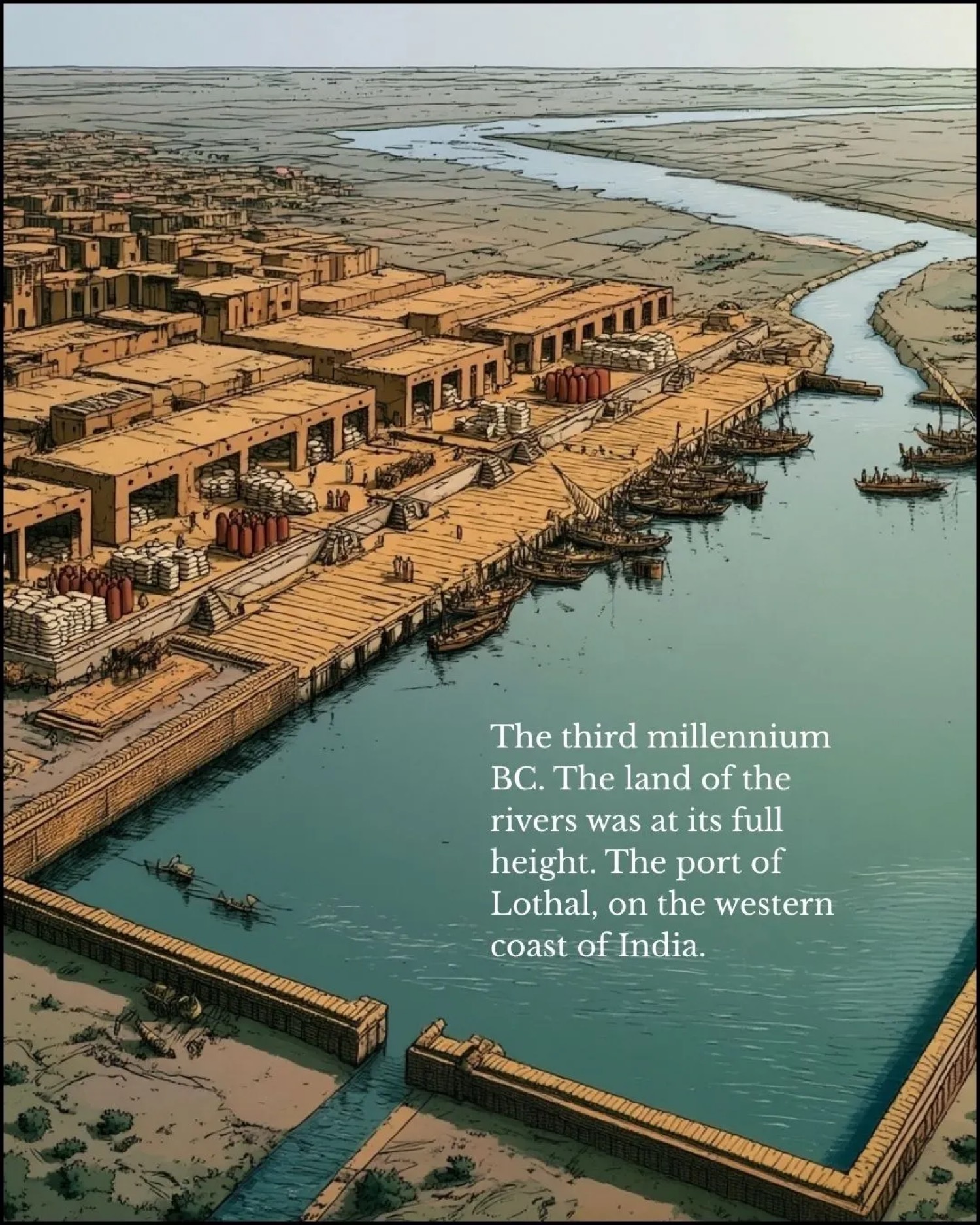
The third millennium BC. The land of the rivers was at its full height. The port of Lothal, on the western coast of India.
Lothal is a real Harappan town on the Gulf of Khambhat. This aerial is an illustration, not a survey photo or a published plate.
Evidence case
What trade can show, and what a seal cannot say
The Indus cities used stamp seals. A seal pressed into clay on a tag, a jar or a storeroom closing is one of the best-documented habits in the corpus. The impression copies a device — often an animal — and a short row of signs. In a warehouse that is a control mark. On a bale that leaves a quay it can travel with the goods. Merchants who never shared a language can still agree that a package is intact, that a weight matches a series, and that a device is familiar.
Objects of that kind did leave the subcontinent. Indus and Indus-style seals and sealings are published from Mesopotamian cities and from the Gulf, including the entrepôt Mesopotamian texts call Dilmun. Carnelian of the long Indus barrel-bead kind is known from Mesopotamian graves. Cubical weights in the Indus series are reported along the same road. None of that requires the script to have been read aloud in Ur.
Mesopotamia wrote about the relationship in its own script. Sumerian and Akkadian texts name Meluhha, list goods, and later mention a Meluhha village in Mesopotamia. Those lines are the nearest outside description of an eastern partner. They are a semantic candidate for contact. They are not a Rosetta stone. A bilingual would put the same statement in both scripts. We do not have one.
The episode’s line — “his customers knew exactly what they meant” — stays in the story, and it is marked unverified. Knowing a trading partner, a sealed lot, and a name in one’s own language is not the same as knowing the value of each Indus sign. This platform does not assign those values. Sign 017 and the other numbers in the seal desk are catalogue places, not a reading of the illustrated seal.
The basin at Lothal is not in doubt as masonry. S. R. Rao read it as a tidal dock with a lock. A freshwater reservoir is the main alternative, and it is still a functional hypothesis, not a correction that deletes the warehouse, the seals or the weights. Ship lengths and tonnages in the panels are reconstructions inside the dock reading. The brick ratio near 4:2:1 is a real shared standard. The ivory scale’s smallest division, near 1.7 millimetres in Rao’s publication, is a structural description of one object. Falcon altars and a Pythagorean proof are unverified geometric proposals. “Largest economy on the planet” is rejected: area is not output, and no Bronze Age GDP exists.
The names behind that caution are the usual ones, and they do not agree with each other: Mahadevan’s concordance, Parpola’s Dravidian hypothesis, Wells and the ICIT sign list, Fuls on corpus counts, Farmer, Sproat and Witzel against a linguistic decipherment, Rao, Yadav and Vahia on syntax-like order, Kenoyer and Vidale on craft and Gulf objects. Disagreement is the point of the ledger. The method is written out on the method page. Primary-source habits live under sources.